
Compression Springs Compression Springs

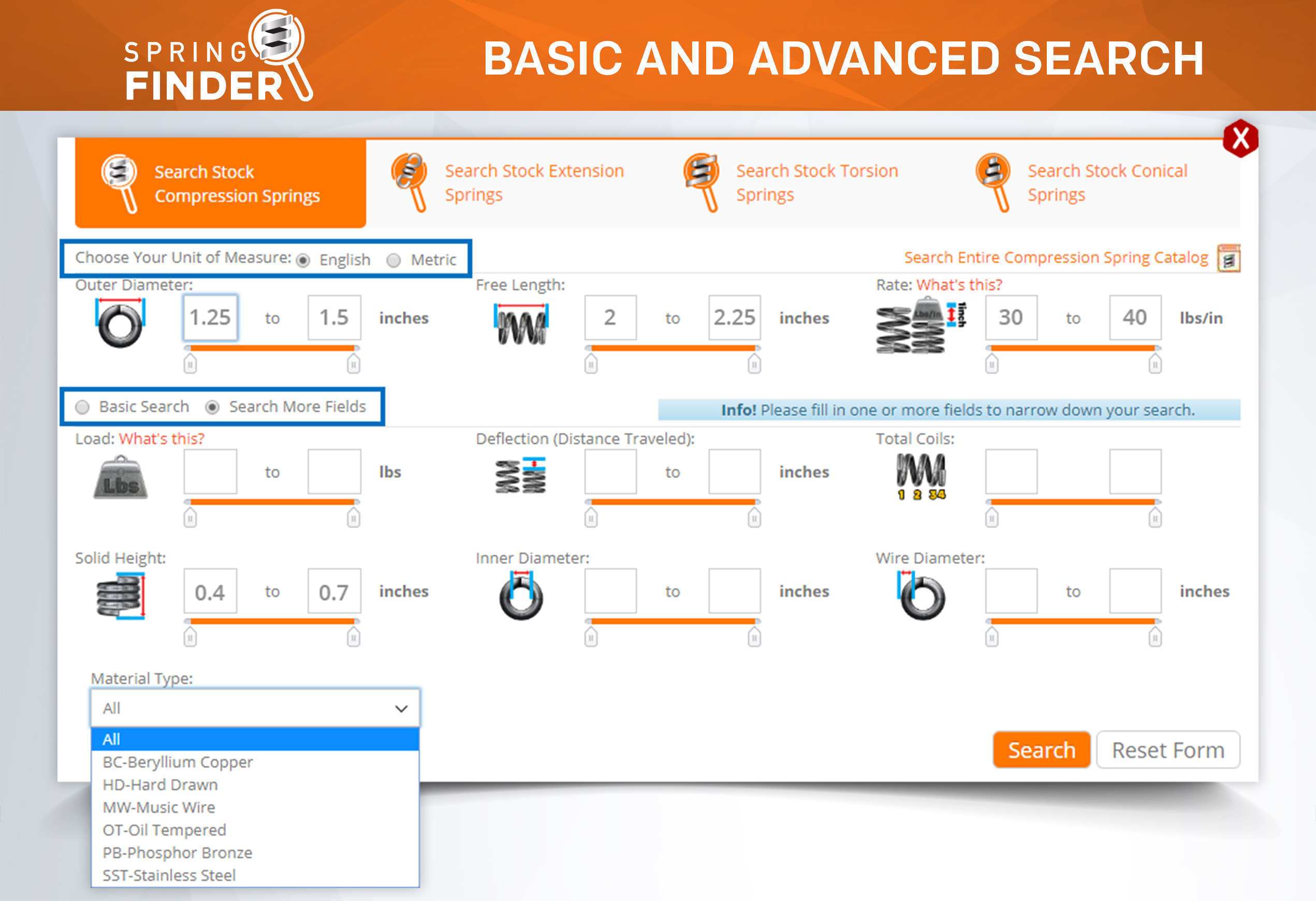
Enter your Outer Diameter and Free Length
Hint: For larger search results, enter a bigger range of Min and Max Inputs

Outer Diameter (in)
Outer Diameter
to
Inner Diameter (in)
Inner Diameter
to
Free Length (in)
Free Length
to
Wire Diameter (in)
Wire Diameter
to
Total Coils
Total Coils
to
Rate (lbs/in)
Rate
to
Material Type
Material Type
Max. Load (lbs)
Max. Load
to
Max. Deflection (in)
Max. Deflection
to
Solid Height (in)
Solid Height
to
*Required Field
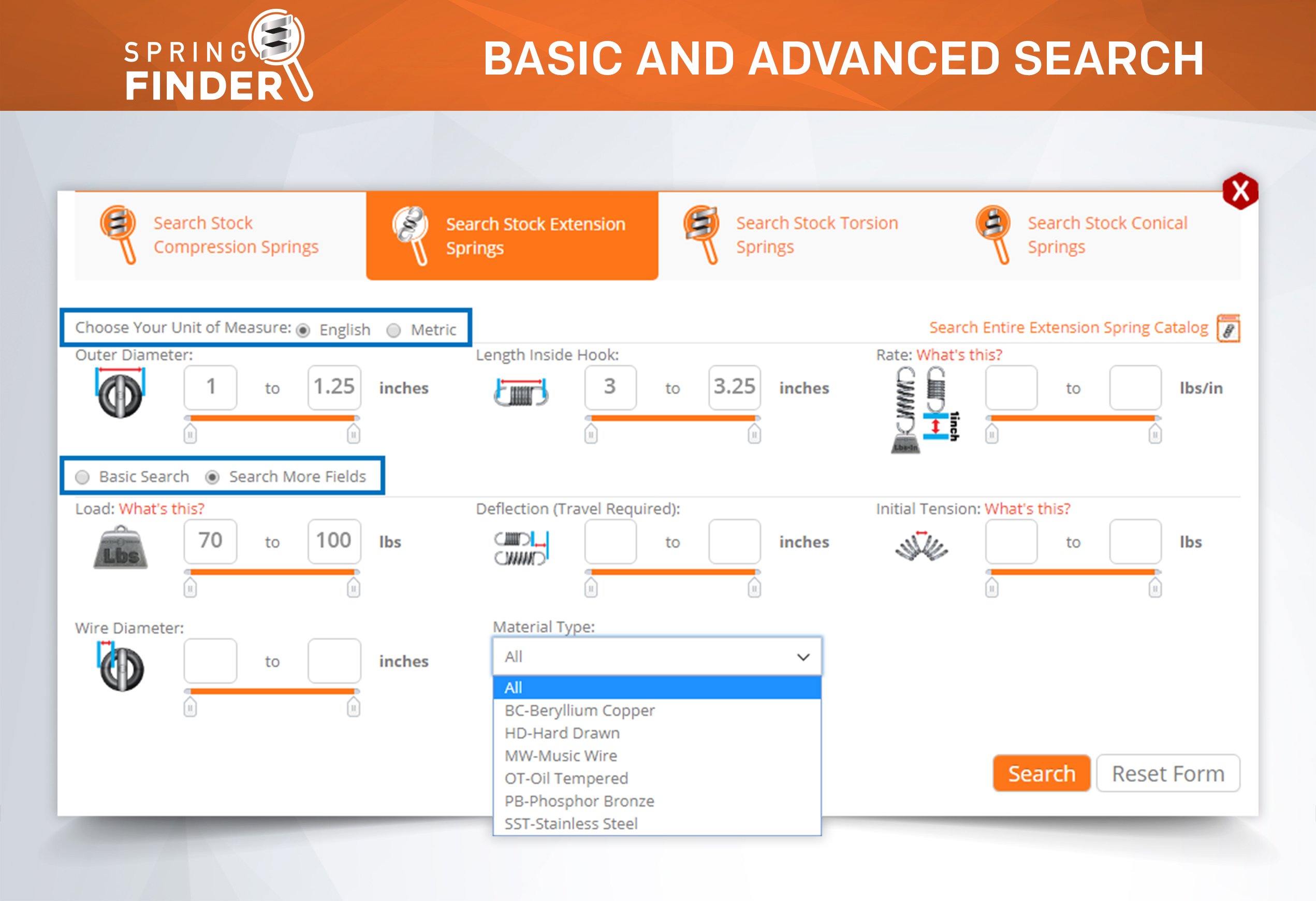
Extension Springs Extension Springs

Enter your Outer Diameter and Length Inside Hook
Hint: For larger search results, enter a bigger range of Min and Max Inputs

Outer Diameter (in)
Outer Diameter
to
Length Inside Hook (in)
Length Inside Hook
to
Wire Diameter (in)
Wire Diameter
to
Max. Load (lbs)
Max. Load
to
Max. Deflection (in)
Max. Deflection
to
Initial Tension (lbs)
Initial Tension
to
Rate (lbs/in)
Rate
to
Material Type
Material Type
*Required Field
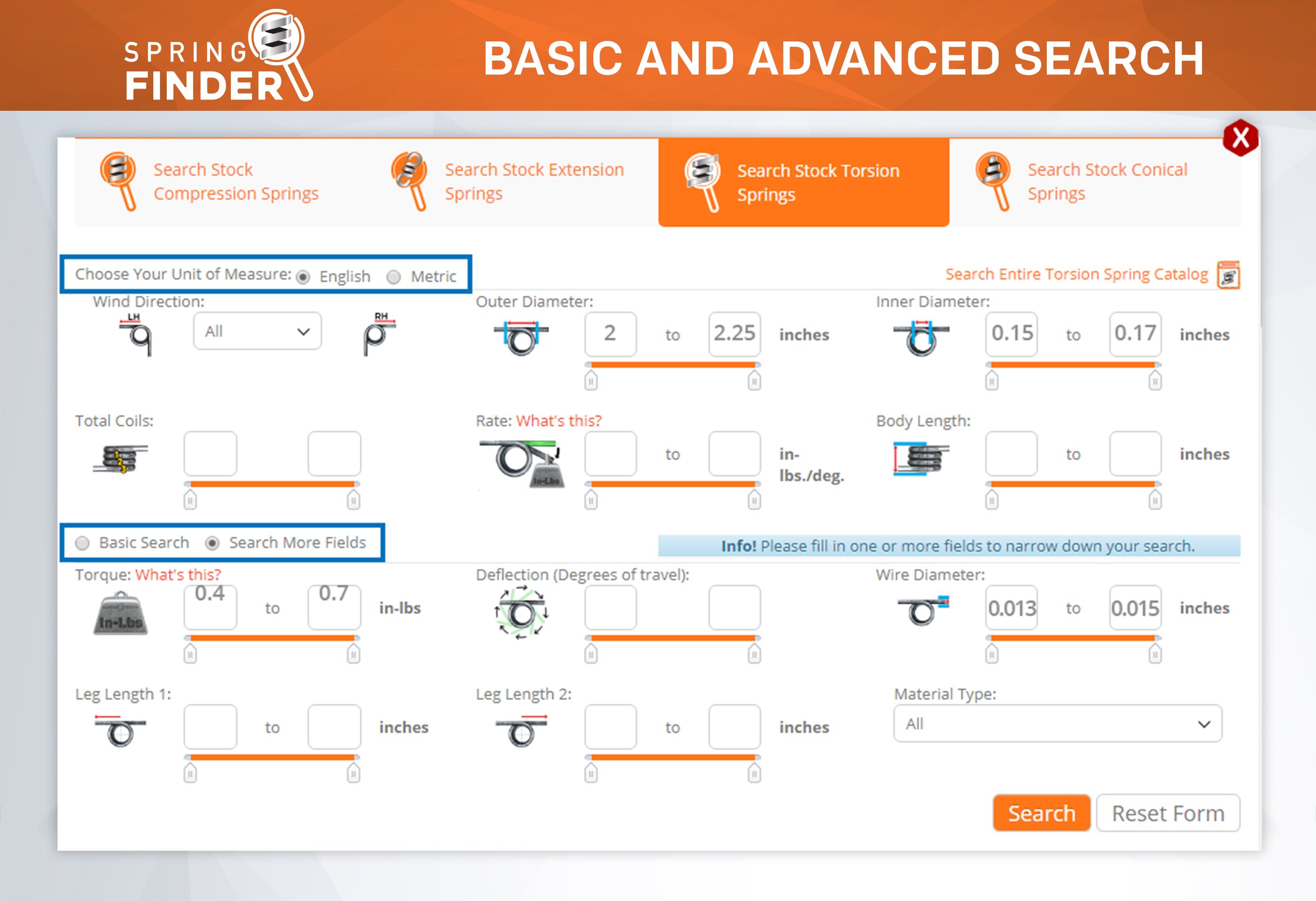
Torsion Springs Torsion Springs

Enter your Outer Diameter and Total Coils
Hint: For larger search results, enter a bigger range of Min and Max Inputs

Outer Diameter (in)
Outer Diameter
to
Inner Diameter (in)
Inner Diameter
to
Total Coils
Total Coils
to
Free Position (deg)
Free Position
to
Wire Diameter (in)
Wire Diameter
to
Body Length (in)
Body Length
to
Wind Direction
Max. Torque (lbs)
Max. Torque
to
Max. Deflection (deg)
Max. Deflection
to
Rate (in-lbs/deg)
Rate
to
Leg Length (in)
Leg Length
to
Material Type
Material Type
*Required Field
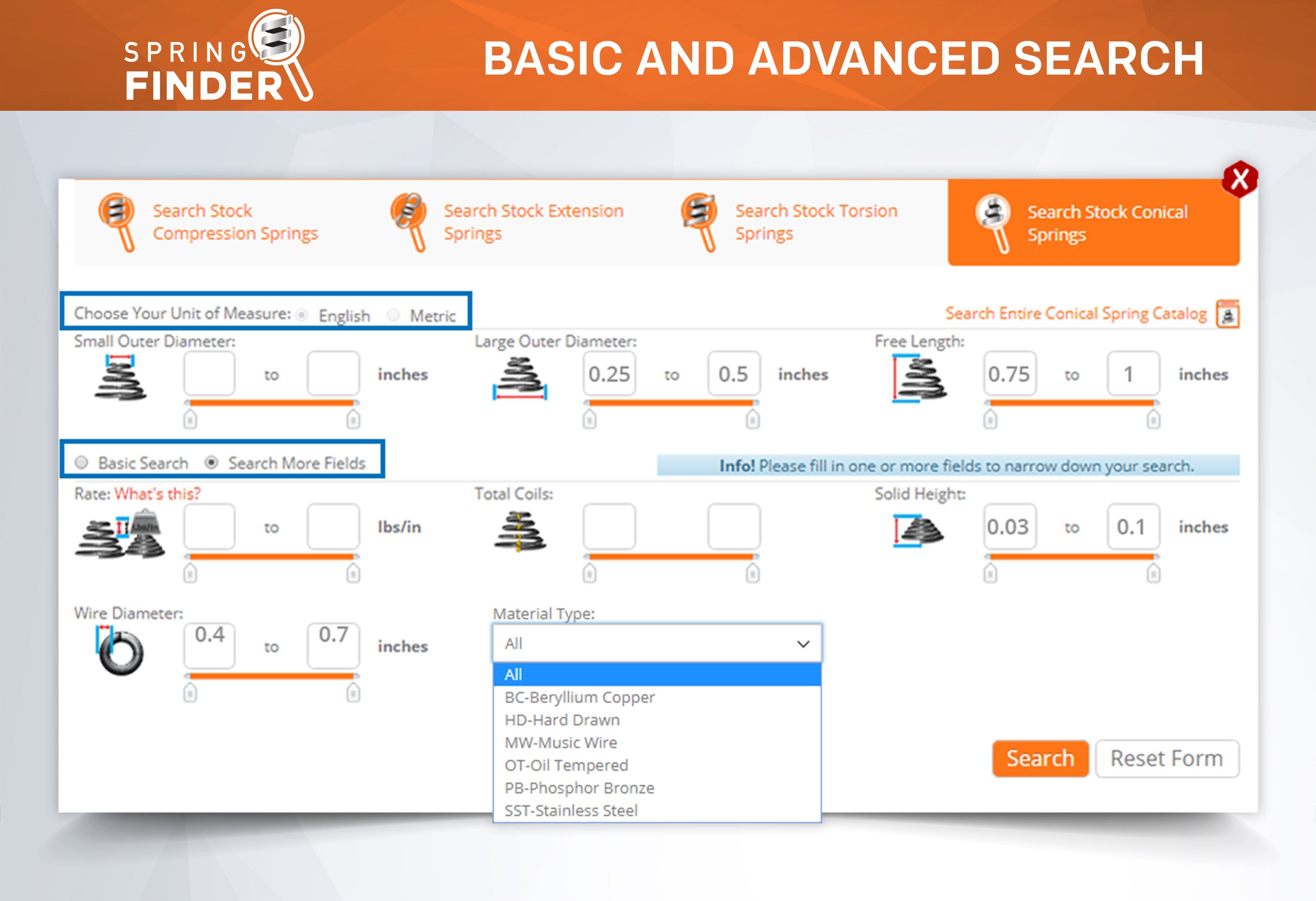
Conical Springs Conical Springs

Enter you Small Outer Diameter, Large Outer Diameter and Free Length
Hint: For larger search results, enter a bigger range of Min and Max Inputs

Small Outer Diameter (in)
Small Outer Diameter
to
Large Outer Diameter (in)
Large Outer Diameter
to
Free Length (in)
Free Length
to
Rate (lbs/in)
Rate
to
Total Coils
Total Coils
to
Solid Height (in)
Solid Height
to
Wire Diameter (in)
Wire Diameter
to
Material Type
Material Type
*Required Field

Compression Spring Measurements - How to Measure A Compression Spring

How to measure a compression spring

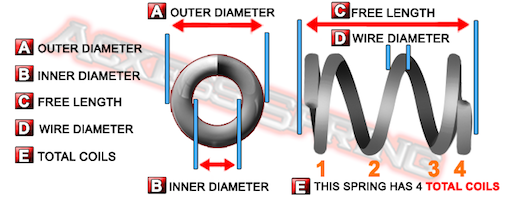
When measuring your compression spring, you must know on the following dimensions:

  • Outer Diameter
  • Inner Diameter
  • Free Length
  • Wire Diameter
  • Total Coils

Please see the graphic on the right for help.

You may calculate your inner diameter by subtracting two wire diameters from your outer diameter as shown in this formula:
OD - 2WD = ID

How to Measure Your Spring

Compression springs measurements and dimensions

Springs are accurately measured with a dial caliper. The reason for this is because a caliper provides you with a more exact measurement. Wondering why this is so important? Well, take your spring's wire diameter as an example. In most cases, if the spring's wire diameter is off by 0.001" it'll affect your spring's rate and travel so one must have exact measurements when measuring a spring.

Another thing you must focus on is your end types. The end types available are the following:

Feel free to visit our Free Online Compression Spring Calculator

Closed and Square The ends are closed and don't have pitch, therefore, not all the coils on your spring will be active; only the coils that have pitch or space in-between the coils are active. In this case you may calculate your active coils by subtracting 2 coils from your spring's total coils: Total Coils - 2 = Active Coils.

Compression spring with closed and square ends

Compression spring with closed and square ends

Closed and Ground These ends are the same as closed and square ends but the ends go through a grinding process that grinds half a wire diameter off the first and last coils so that your spring will stand vertically. The calculation process for active coils is the same as the one used for closed and square ends. Total Coils - 2 = Active Coils.

Compression spring with closed and ground ends

Compression spring with closed and ground ends

Double Closed and Square ends These ends are closed but the first two coils and last two coils are touching. To figure out the active coils when it comes to this type of ends, you'll have to subtract 4 coils from your total coils: Total Coils - 4 = Active Coils.

Compression spring with double closed ends

Compression spring with double closed ends

Open Ends These ends are the opposite of closed and square ends because the ends don't close and don't have pitch. Therefore, all the coils of a spring with open ends are active.

Compression spring with open ends

Compression spring with open ends
How to measure a compression springHow to measure a compression spring

When measuring your compression spring, you must know on the following dimensions:

  • Outer Diameter
  • Inner Diameter
  • Free Length
  • Wire Diameter
  • Total Coils

Please see the graphic on the right for help.

You may calculate your inner diameter by subtracting two wire diameters from your outer diameter as shown in this formula:

OD - 2WD = ID

Compression springs measurements and dimensionsCompression springs measurements and dimensions

Springs are accurately measured with a dial caliper. The reason for this is because a caliper provides you with a more exact measurement. Wondering why this is so important? Well, take your spring's wire diameter as an example. In most cases, if the spring's wire diameter is off by 0.001" it'll affect your spring's rate and travel so one must have exact measurements when measuring a spring.

Another thing you must focus on is your end types. The end types available are the following:

Feel free to visit our Free Online Compression Spring Calculator

Compression spring with closed and square endCompression spring with closed and square end

Closed and Square The ends are closed and don't have pitch, therefore, not all the coils on your spring will be active; only the coils that have pitch or space in-between the coils are active. In this case you may calculate your active coils by subtracting 2 coils from your spring's total coils: Total Coils - 2 = Active Coils.

Compression spring with closed and ground endsCompression spring with closed and ground ends

Closed and Ground These ends are the same as closed and square ends but the ends go through a grinding process that grinds half a wire diameter off the first and last coils so that your spring will stand vertically. The calculation process for active coils is the same as the one used for closed and square ends. Total Coils - 2 = Active Coils.

compression_spring_with_double_closed_endscompression_spring_with_double_closed_ends

Double Closed and Square ends These ends are closed but the first two coils and last two coils are touching. To figure out the active coils when it comes to this type of ends, you'll have to subtract 4 coils from your total coils: Total Coils - 4 = Active Coils.

Compression spring with open endsCompression spring with open ends

Open Ends These ends are the opposite of closed and square ends because the ends don't close and don't have pitch. Therefore, all the coils of a spring with open ends are active.