Torsion Spring Torque Calculator
Stop Struggling with Math: My Go-To Calculator for Your Torsion Spring Projects
Table of Contents
- What Makes Torsion Spring Calculations Challenging?
- What Is Hooke’s Law for Torsion Springs?
- How Do You Use the Torsion Spring Equation to Calculate Torque, Rate, and Deflection?
- How Can an Online Torsion Spring Calculator Make Your Life Easier?
- How Do You Go from Calculation to Finding the Right Spring?
- What Are the Key Takeaways from This Torsion Spring Guide?


Torsion springs are a bit more complicated than your average compression or extension spring. For one, they don’t simply squeeze or stretch in a straight line, instead, they exert a rotational force (torque). This means they travel in degrees of deflection, not in inches or millimeters. If you've designed other springs before, you'll notice a torsion spring has many factors to consider, from the direction of wind (left-hand vs. right-hand coil) to the free position of the spring’s legs. All these specifics influence the spring’s behavior. It’s no wonder that calculating a torsion spring can feel tricky!
Torque, in a torsion spring, is basically the spring’s “working load,” but applied through a twisting motion rather than a linear push or pull . Because of this, figuring out the exact torque for a given twist (angle) isn’t as straightforward as measuring a compression spring’s force over an inch of travel. Many newcomers find themselves asking: “How do I calculate the force for a spring that twists instead of compresses?” The challenge comes from converting that rotational movement into useful numbers.
The difficulty also lies in ensuring your spring will work in real life. A torsion spring changes geometry as it deflects, its coils tighten, and its body length can increase slightly. If you miscalculate, you might end up with a spring that over-stresses (and potentially fails) or doesn’t fit your assembly. With so many variables (wire diameter, coil diameter, leg length, number of coils, etc.), doing all the math manually can be a headache. That’s exactly why having a reliable tool at your fingertips is a game-changer. Before we get to the tool, though, let's cover the core equation that governs every torsion spring design. Trust me, a little theory now will make using the calculator much more intuitive later.
You might recall Hooke’s Law from basic physics: for a linear spring, Force = k × displacement (where k is the spring constant). Torsion springs follow a similar principle, but in angular form. In fact, as long as you stay within the spring’s elastic limit, a torsion spring obeys an angular version of Hooke’s Law. In simple terms:
Torque (τ) = k * θ
where τ is the torque the spring exerts, θ is the angle of twist (usually measured from the spring’s free position), and k is the torsional spring constant . This constant k (sometimes called the torsion spring rate or torsion coefficient) tells us how much torque is needed to rotate the spring by a certain angle . It’s analogous to the spring constant in a linear spring, except the units are in torque per angle (for example, inch‐pounds per degree, or Newton‐meters per radian, etc.).
So, what does Hooke’s Law mean in practice for a torsion spring? It means that torque increases linearly with angle , twist the spring twice as far (2θ) and you get about twice the torque (2τ), as long as you haven’t exceeded what the spring can handle. This proportional relationship is hugely helpful. It lets us predict how a spring will behave under different twists. It’s the foundational torsion spring equation that we’ll use to calculate everything from spring rate to required torque. Keep in mind, though, Hooke’s Law holds until the material’s elastic limit, push a spring too far, and the relationship no longer stays linear (and the spring may deform permanently). But for normal operating ranges, it’s a straight-line relationship between angle and torque, a very convenient fact for engineers!
If you’re a bit of a physics nerd (like me), it’s comforting to know the math checks out. But even if you’re not, understanding that torsion springs behave predictably, torque in proportion to angle, should give you confidence. Next, let's use this knowledge to write out the actual formulas we need for solving spring design problems.
When working with torsion springs, there are three key variables tied together by the torsion spring equation: Torque (T), Spring Rate (k), and Deflection (θ) . If you know any two of these, you can find the third. Here’s the core relationship:
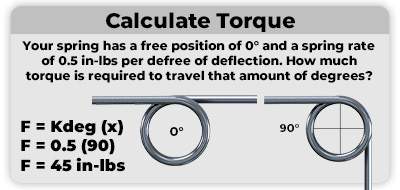
Torque = Spring Rate per degree × Deflection (angle).
This is essentially Hooke’s Law for torsion springs. For example, if a spring’s rate is 0.5 inch-pounds per degree, and you twist it 20 degrees, it will exert 0.5 × 20 = 10 inch-pounds of torque.
We can flip that formula around depending on what we need to find:


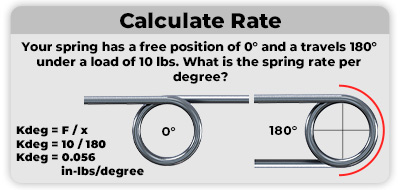
Spring Rate per degree = Torque ÷ Deflection.
If you measure a spring and find it delivered 10 in-lb of torque at a 20° twist, then its rate Kdeg = 10 / 20 = 0.5 in-lb/degree. This is sometimes called the torsional spring constant equation , giving you the spring’s stiffness in rotational terms. Engineers often calculate this to compare how “stiff” or “soft” one torsion spring is relative to another.


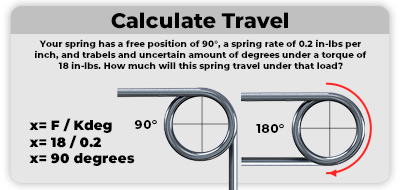
Deflection (Angle) = Torque ÷ Spring Rate.
Suppose you know your spring’s rate and the torque you need it to provide. This formula tells you how far you must twist the spring to get that torque. For instance, if you require 6 in-lb of torque from a spring with rate 0.5 in-lb/deg, you’d need θ = 6 / 0.5 = 12 degrees of twist. This is essentially the angular deflection formula for the torsion spring under a given load.


The fundamental torsion spring equation ties all these together:
T = k × θ (Torque = Spring Rate × Deflection).
Everything else is just algebra: k = T/θ or θ = T/k, whichever helps you solve your problem. It’s elegant, really, how this one relationship covers rate, torque, and deflection.
But here’s the thing: you don’t actually need to calculate that by yourself. Modern tools (like the one I’m about to introduce) handle all those heavy formulas instantly. You just input your spring’s specifications, and the software computes the spring’s rate, torsion spring torque calculations, safe travel limits, and more in one go. Still, it’s good to know the formulas above, because it helps you understand what the calculator is doing and why the results make sense. Armed with this theory, you can trust the numbers it gives you.
Imagine having a free online torsion spring calculator where you punch in a few specs and instantly get all the answers, sounds handy, right? That’s exactly what we have at The Spring Store. Our torsio
n spring design tool (powered by our Spring Creator) takes the guesswork out of the design process. You simply enter your torsion spring specifications (like wire diameter, coil diameter, number of coils, material, and the angle you need to wind it) and hit calculate. In real time, the calculator will spit out key results : spring rate (spring constant), maximum torque, and even the maximum safe travel for the spring. No more manual unit conversions or worrying if you divided when you should have multiplied, the tool handles it all with precision.


What I love about this online torsion spring calculator is how it speeds up the design phase. You can tweak inputs on the fly, say you want to try a slightly thicker wire or an extra coil, and see the new torque and rate results immediately. The software uses advanced spring equations under the hood, so even though it feels easy, you’re actually leveraging the same complex formulas the pros use . It’s like having a spring engineer doing math for you in the background (in fact, it was built by spring engineers!). It incorporates all those spring force formulas and equations for torsion springs to analyze your design, but it simplifies the experience so you don’t have to wrestle with the math yourself.
Another neat feature is the visual feedback. Our calculator can generate a quick blueprint of your spring based on your inputs. This helps in ensuring your design “looks” right, for instance, you’ll notice if the legs are oriented correctly or if the coil looks too tight or too loose. For beginners and students, this visual cue can be super helpful to connect the numbers with a real-world spring shape.
So far, we’ve covered how to get those crucial torsion spring numbers quickly. Now, here’s where the magic happens: turning those results into actual springs you can buy or build. The Spring Store’s calculator doesn’t just leave you with the math, it helps you take the next step immediately. Let’s see how it bridges the gap from calculation to purchase.
One of the smartest aspects of our torsion spring calculator is its seamless integration with The Spring Store’s inventory and custom manufacturing services. The moment you calculate and get your spring’s specs, the tool effectively becomes a stock torsion spring finder. It will automatically search our extensive catalog of stock torsion springs to find any close matches to the design you've just calculated. For example, if you determine you need a spring with a 0.5 in-lb/deg rate and a certain coil size, the calculator can suggest readily available stock torsion springs that meet those specifications (or come very close). This is extremely handy, instead of manually comparing your requirements against catalog tables, the tool does it in seconds. It’s like having a personal shopper for springs!


If a suitable stock spring pops up, you can click on it to view details, pricing, and even order it right away. Buying a standard spring off the shelf can save a ton of time and money, and our site makes that connection effortless. The integrated Spring Finder uses your input parameters (outer diameter, wire diameter, free length, leg length, etc.) to cross-reference with the inventory . Essentially, the calculator doubles as an advanced search tool for available springs.


Oh, and if at any point you feel unsure or have a question (maybe you're not certain about one of your torsion spring specifications, or you wonder if you could tweak the design for longer life), you can contact our spring experts directly. We have engineers on standby, (the same folks who developed these calculators), ready to offer guidance. So whether you find a stock spring or need a custom one, you're not alone. We’ll help ensure the spring you end up with is the right fit for your project.
Let’s wrap up with a quick recap. Torsion springs might seem daunting at first, but with the right understanding and tools, you can master them. Here are five key takeaways from this article to remember:
-
Torsion springs follow Hooke’s Law in rotation: Torque is proportional to angular deflection (twist) . In other words, they have a linear torque-angle relationship (within elastic limits), just like linear springs have with force and length.
-
Key formulas connect torque, rate, and deflection: The fundamental torsion spring equation is T = k × θ . From that, you can find spring rate (stiffness) by T/θ or required angle by T/k . These simple formulas let you calculate torsion spring torque or any missing variable easily.
-
Online calculators simplify complex design work: You don’t need to manually use complicated formulas like Ed^4/(10.8DN) to get your spring constant . Our online torsion spring calculator instantly computes spring rate, torque per degree, safe travel, and more, saving you time and preventing errors.
-
The tool bridges theory to purchase seamlessly: After crunching the numbers, the calculator doubles as a torsion spring finder, showing you comparable stock springs in our catalog . If no stock fits, it offers an instant custom spring quote . This way, you can go from solving equations to ordering a spring in one continuous workflow.
-
The Spring Store is your expert spring partner: Backed by over 30 years of spring manufacturing experience, we provide not just products but guidance. We’re a manufacturer with deep technical know-how, ready to assist with custom torsion spring designs and ensure you get the optimal solution. Don’t hesitate to contact our team for any spring questions or custom needs, we’re here to help!
By keeping these points in mind, you can approach your next torsion spring project with confidence. No more struggling with math on your own, leverage the tools and expertise available to make your design process smoother and more productive. Happy spring designing, and remember that our spring experts are just a call or click away if you need them!
Invest in precision and quality
Spring Creator 5.0 offers you the possibility to design springs that perfectly fit your needs. Our platform not only allows you to design various types of springs but also provides advanced tools like the Online Spring Force Tester to simulate and evaluate spring performance. Visualize your design in 3D, download detailed blueprints, and get instant quotes. Try it for free and discover why we are the preferred choice of engineers and makers!
Created by Alfonso Jaramillo Jr
President Acxess Spring
Over 40 Years of Experience in Spring Engineering and Manufacturing