





Spring for Knives
Definition: Torsion springs used in the mechanisms of retractable knives to allow the knife to swing out automatically with the push of a button.
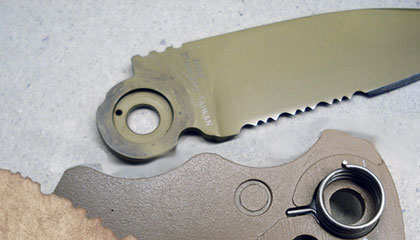
Springs for knives are torsion springs. Torsion springs are known for exerting a radial force which is needed in the case of a knife such as a switchblade. The spring is torqued or "loaded" when the knife is closed. The button that triggers the blade open releases the spring's leg attached to the blade so the stored energy in the spring's coils from the pre-torque, make the spring push its leg up to its free position.
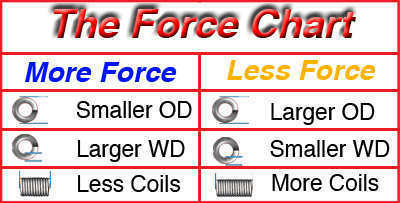
Switchblades are also known as automatic knives, pushbutton knives, ejector knives, and a variety of other names. The stronger your spring is, the faster it'll swing out but the harder it'll be to fold it back in. To understand this concept, we've provided our torsion spring force chart.
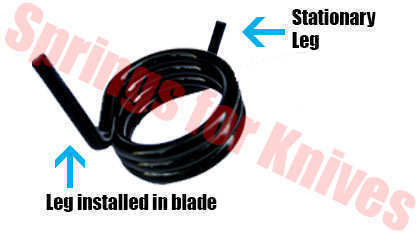
These springs usually have 3.75 or 4.75 coils and their legs have offset bends. One of them, the one inserted on the bottom of the blade, is coming off of the spring's body while the other leg, the stationary one, has the offset bend coming off of the outer diameter as shown on the diagram following the force chart.
Because these springs are very small and must be very strong in order for the knife of the switchblade to swing out in the speed it does, the spring may be pre-torqued for more than 180º, which is the distance traveled from when it is closed to when it is opened. These springs can be pre-torqued at 270º in order for you to get the amount of torque you need when it is opened.
Stainless Steel 17-7 is used for these springs for several reasons. It is stainless steel so it will not rust when it makes contact with water and it is able to resist very elevated temperatures. This material also has a high tensile strength thus making your spring stronger but its properties also make it a more flexible material type so you are able to get the distance traveled you need.
The material type isn't the only factor that plays in your spring's torque though. This spring has very little coils which usually makes a spring stiffer but it it also has a good spring index. The spring index is the ratio of your spring's diameter in proportion to the wire diameter. If the spring index isn't too tight. Your spring will be under less stress thus being able to travel more.